
Website Copywriting Tips for Therapists: Why Your Homepage Structure Is Costing You Clients

If you prefer to watch instead of read about these copywriting tips for therapists, check out the full YouTube video here:
She'd done everything right.
Her website was live. The colors were beautiful. She had a professional headshot, a warm welcome message, and three paragraphs explaining her therapeutic approach. She listed her credentials, her training, her areas of focus. She even had a contact form. By every standard she'd been taught, the website was complete.
And nobody was reaching out.
When she came to me, she was frustrated in that quiet, defeated way that therapists get when they've put real effort into something and it still didn't work. She said, "I don't know what's wrong with it. It's got everything it's supposed to have." And she was right. It did have everything. It was just in the wrong order, saying the wrong things, to no one in particular. She'd followed every rule she knew. The problem was that the rules she knew were written for graduate school, not for a homepage. And the moment we rebuilt the foundation, everything changed.
That's what this post is about. I'm going to walk you through a self-audit so you can see exactly where your homepage is losing people, a deep dive into the sections therapists get most wrong, the real patterns I see in client work that nobody talks about, and how to fix all of it before you write another word.
Before we go further, book your FREE Discovery Call. It's the first step in getting clear on the process for understanding who your website is for, what it needs to say, and what order it needs to say it in before you write a single word.
Table of Contents
The Homepage Self-Audit: How Is Yours Actually Doing
The Sections Therapists Get Most Wrong and How to Fix Them
The Real Reason Your Website Copy Isn't Landing
Three Tips for Writing a Homepage That Actually Works
Common Mistakes to Avoid
What to Do Next
FAQ
The Homepage Self-Audit: How Is Yours Actually Doing
Pull up your homepage right now. Read it the way a potential client would, meaning fast, on your phone, with half your attention somewhere else. Then answer these questions honestly.
Does your very first headline name who you help or what problem you solve? Yes or No.
Does your homepage make a potential client feel understood within the first two sections? Yes or No.
Is your homepage free of the word "Welcome" or any variation of it in your hero section? Yes or No.
Does your copy describe your client's actual life in specific, concrete language rather than general phrases like "overwhelming" or "life's challenges"? Yes or No.
Does every section of your homepage have a clear, specific job it is doing for the reader? Yes or No.
Is your copy written in short, punchy paragraphs rather than long walls of text? Yes or No.
Does your homepage address at least one reason a potential client might hesitate before reaching out? Yes or No.
Does your homepage end with one clear, specific call to action? Yes or No.
If you answered No to three or more of those questions, your homepage structure may be the reason the right clients aren't reaching out.
I know, I know….but chill….the good news is that every single one of those is fixable. Keep reading.
The Sections Therapists Get Most Wrong and How to Fix Them
Most therapists don't have a framework for their homepage. They add what they think should be there, arrange it in an order that feels logical to them, and end up with a page that has all the right ingredients in all the wrong places. Every section of a homepage has a specific job to do. When a section doesn't do its job, the reader loses the thread and leaves.
Here are the four sections I see therapists get wrong most often and exactly how to fix them.
The Hero Section
The hero section is the very first thing someone sees when they land on your page. It has one job: make the right person feel seen immediately so they know they're in the right place. That's it. Not impress them. Not introduce yourself. Not sell them something. Make them feel seen.
Here's what I see therapists put in their hero section instead. They open with "Welcome to my practice." They write something like "A place where healing begins" or "Compassionate therapy for individuals and couples." They list their name and credentials right at the top. Every single one of those choices wastes the most valuable real estate on your entire website.
Think about it from your reader's perspective. They landed on your page because they were searching for help. They are not looking for a warm welcome. They are looking for a sign that they found the right person. "Welcome to my practice" tells them nothing. It could be the opening line of any therapist's website anywhere in the country.
Here's how to write a hero section that actually works. Lead with a specific headline that names who you help and what changes through the work. Follow it with a subheadline that speaks directly to what their life feels like right now and the transformation they get working with you. Then put one clear call to action button. That's the whole section.
A weak hero looks like this: "Welcome. I'm Dr. Johnson, a licensed therapist helping individuals and couples find balance and peace."
A stronger hero looks like this: "Anxiety therapy for high-achieving Black women in Atlanta who are tired of overthinking everything and ready to actually trust themselves."
The stronger version tells the reader in one sentence whether they're in the right place. The weak version tells them almost nothing.
Speak to the Struggle
This is the section where you name what your client's life actually feels like right now, before they've worked with you, before anything has changed. This section has one job: make them think "wait, how did they know that."
What I see therapists write instead is language so broad it could apply to anyone. "You're feeling overwhelmed and ready for change." "Life feels hard and you're not sure where to turn." "You've been struggling and you deserve support." Those phrases have appeared on so many therapy websites that they've stopped meaning anything to anyone.
The fix is specificity. You're not trying to describe every possible client. You're trying to describe one specific person so precisely that when they read it, they feel like you already know them.
Here's how to write it. Think about the last three clients you worked with who were a perfect fit for your practice. What did they say in their intake forms? What words did they use to describe what was wrong? What did their day-to-day actually look like? Write that down in their language, not yours. Then put those words on your website.
A weak “Speak to the Struggle” section sounds like this: "You're feeling stressed, overwhelmed, and like you can't keep up."
A stronger version sounds like this: "You say yes when you mean no. You replay the conversation on the drive home. You're exhausted in a way that a good night's sleep hasn't fixed in months."
The second version is specific enough that the right person reads it and feels seen. The wrong person reads it and self-selects out. Both of those outcomes are exactly what you want.
The Value Proposition
This is your I help statement followed by a short paragraph about how you work. Its job is to connect the struggle you just named to the actual work you do, in plain language that a non-therapist can understand immediately.
What I see therapists write here (if they even know what a value proposition is🤷🏽♀️ ) is either too clinical or too vague. Too clinical sounds like "I use an integrative, trauma-informed approach to support nervous system regulation." Too vague sounds like "I help people develop tools for a more fulfilling life." Both miss the mark for the same reason. They describe the method instead of the outcome, and they use language the reader has to decode.
Here's how to write it. Finish this sentence out loud, the way you'd explain it to a friend at dinner: "I help blank (people) do blank so they can blank." Whatever comes out of your mouth naturally is almost always more specific and more human than what ends up on most therapy websites. Write that down.
A weak value proposition sounds like this: "I help individuals find balance and develop coping tools for a more fulfilling life."
A stronger one sounds like this: "I help high-achieving Black women untangle the anxiety that shows up as perfectionism, people-pleasing, and never feeling like enough, so they can make decisions with confidence and stop second-guessing themselves at every turn."
The stronger version is specific about who it's for, what the problem actually looks like in real life, and what changes through the work. A reader who fits that description reads it and thinks, okay, this is exactly what I need.
Meet the Therapist
This section is a short personal intro and its job is warmth and connection. The reader needs to feel like they know who they'd be sitting across from before they ever book a call. This is not the place for your full professional bio. It's not a resume. It's the beginning of a relationship.
What I see therapists write here is a list of credentials and clinical experience dressed up in warm language. "I am a licensed professional counselor with over ten years of experience helping clients achieve their goals. I use a collaborative approach and believe in the power of the therapeutic relationship." That sounds professional. It also tells the reader nothing about who you actually are.
Here's how to write it instead. Lead with your why. Why did you become a therapist? What lived experience or personal conviction drives the work you do? One or two specific sentences about that will do more to build trust than a full paragraph of credentials. Then briefly name who you love working with and what you find meaningful about that work. Then you can mention your license, your training, and your approach. In that order.
A weak “Meet the Therapist” section sounds like this: "I'm a licensed therapist with a master's degree in clinical counseling. I specialize in anxiety, depression, and relationship issues and use evidence-based approaches to help my clients reach their goals."
A stronger version sounds like this: "I became a therapist because I know what it feels like to be the strong one in every room and never feel like you can relax and just “be”. That experience lives in every session I hold. I work with high-achieving Black women who are done performing “okay” when they're not, and I am genuinely honored to do this work."
The second version tells the reader who you are, why you do this, and who you do it for. By the time they finish reading it, they already feel something. That is exactly the job this section is supposed to do.
The Real Reason Your Website Copy Isn't Landing
Here's what I haven’t seen any other website resource for therapists say directly. The reason most therapy websites don't work has nothing to do with the design, the platform, or even the writing itself. It has to do with what happened before the writing.
Most therapists sit down to write their website without having done the foundational work of brand strategy first. And because that work hasn't been done, the words on the page are empty. They sound nice. They're grammatically correct. They're warm and professional. But they don't resonate with anyone in particular because they weren't written with anyone specific in mind.
Brand strategy is where you get clear on who your ideal client actually is, not just demographically, but experientially. What does their day feel like? What have they tried before that didn't work? What are they afraid of? What do they want more than anything? What specific problem does your work solve for that specific person? When you can answer those questions clearly and specifically, your website copy almost writes itself. When you can't, you end up filling the page with words that sound like every other therapist's website.
This is also where the wall-to-wall text problem comes from. When a therapist doesn't have a clear picture of who they're writing to, they try to cover everything. They write long paragraphs that loop back on themselves, add qualifiers to every sentence, and bury the actual point somewhere in the middle of the third paragraph. A reader who is skimming your page, which is every reader, will not find it. They'll leave.
Clear brand strategy produces clear copy. Vague brand strategy produces a website full of words that technically say something but don't actually mean anything to the person reading them.
Three Tips for Writing a Homepage That Actually Works
Write to one specific person, not to everyone. This is the single most important shift you can make. When you try to write copy that could apply to any potential client, you end up with copy that resonates with no one. Pick one person. The person you most want to work with. The client who lights you up, whose work feels meaningful, who you'd take every day if you could. Write every section of your homepage directly to that person. The specificity will feel risky. It's not. The more specific you are, the more the right people will feel like you're speaking directly to them.
Say the most important thing first, then stop. Therapists are trained to be thorough. That training produces great clinicians and very wordy websites. On a homepage, every section should lead with the most important sentence, full stop. If someone reads only the first sentence of each section, they should still understand who you help, what you do, and why they should reach out. Everything else in the section supports that first sentence. It does not add to it or repeat it. Say the thing, then stop.
Do the brand strategy work before you touch the website. This is not optional and it is not something you can shortcut by filling in a template. Brand strategy is the research and clarity work that tells you who your ideal client is, what their life actually feels like, what they want, and how your specific work addresses it. Without it, you're guessing at what to say. And guessing produces copy that sounds professional but doesn't convert. Every section of your homepage is only as strong as the information behind it. Get that information first.
If you're ready to stop guessing and start with the strategy, grab my free Website Direction Plan. It'll get you started with documenting exactly what you need to know about your ideal client and your messaging before you write a word of your homepage copy.
Common Mistakes to Avoid
Opening your hero section with "Welcome." I see this constantly and I understand why it happens. It feels warm. It feels professional. It feels like the right way to greet someone. But "Welcome to my practice" is the homepage equivalent of a firm handshake and a business card. It gives the reader zero information about whether they're in the right place. You have about five seconds before a visitor decides to stay or leave. Spending those five seconds on a greeting is a real cost. Lead with who you help. The warmth can come through in how you say it.
Asking for the sale before you've made the connection. A lot of therapy websites jump to services before the reader has any reason to invest. If your services are listed immediately after your hero section, before saying a single thing about who the therapist helps or what changes through the work, you can loose the reader. That's the equivalent of someone walking up to you at a party and asking you to marry them before they've told you their name. The reader needs to feel understood first. A description of the services belongs after the connection has been made, not before it.
Writing in walls of text. Long dense paragraphs on a homepage are one of the fastest ways to lose a reader who is skimming. And every reader is skimming. When your copy is hard to read at a glance, it signals to the reader that figuring out whether you're the right therapist is going to require work. They will not do that work. They will click away. Keep your paragraphs to two or three sentences. Put the most important sentence first. Use white space intentionally. Make it easy for someone to understand your message in thirty seconds flat.
Skipping the framework and adding what feels right. A homepage without a framework is just a collection of sections that may or may not be doing anything useful. Every section of a homepage has a specific job. The hero makes the reader feel seen. The proof bar builds credibility. The struggle section creates recognition. The value proposition connects the problem to the solution. When you add sections based on what feels like it should be there, you end up with a homepage that has no throughline, no momentum, and no clear path from first impression to inquiry. Before you write a single word, know what every section is supposed to do.
NOT SURE IF COPY IS REALLY WHERE YOU SHOULD START?
Figure Out What Your Website Needs First.
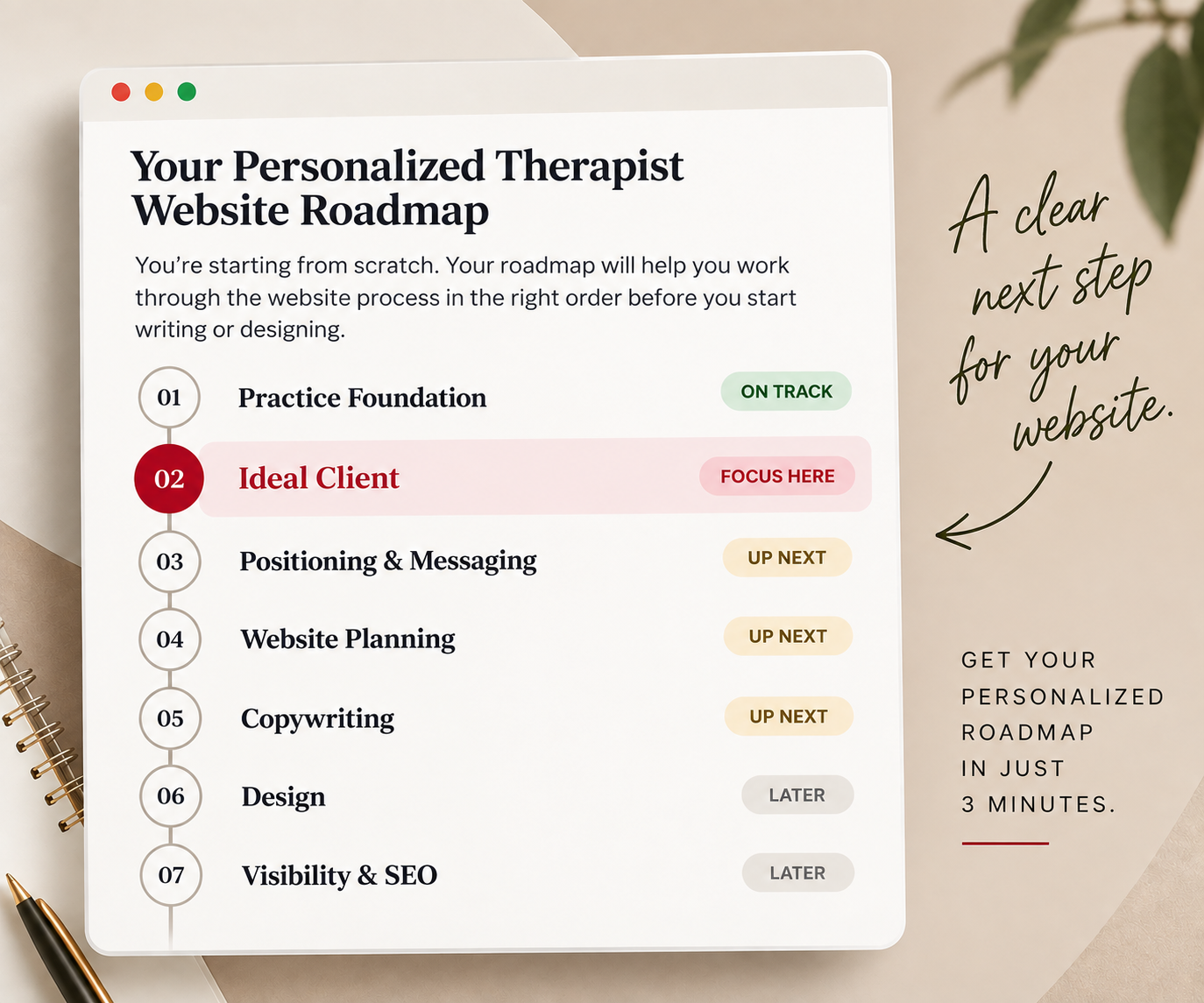
Your homepage copy may need work. But before you start rewriting it, it’s worth looking at the bigger picture—your practice foundation, ideal client, positioning, messaging, and website plan all affect the copy you eventually put on the page.
Take my free 3-minute Therapist Website Assessment and get your Personalized Therapist Website Roadmap showing you where to focus and what comes next.
What to Do Next
Your homepage is the first real conversation you have with a potential client before they ever send an email or book a call. And just like in a session, what you say, how you say it, and the order you say it in changes everything. The therapist I told you about at the beginning of this post rebuilt her entire website with a clear framework, specific language, and copy that was written for one specific person. She didn't change her specialty. She didn't change her rates. She changed the foundation. Soon she had inquiries from clients who said her website felt like it was written specifically for them.
That outcome is available to you. And it starts before you write a single word of copy. It starts with brand strategy. It starts with getting clear on who you're talking to, what their life actually feels like, and how your specific work addresses it. Once you have that clarity, the framework gives you the structure. The copywriting tips in this post give you the execution. But the clarity has to come first.
If you're ready to take the first step, book your FREE Discovery Call. It'll get you started on understanding what it takes to develop a clear messaging foundation before you touch a single section of your website.
And if you're ready to have the whole thing built for you, my S.I.T.E. Prep Method™ is where we do this work together from the strategy all the way through to a live site.
Until next time,
Chrys 😘
Keep Exploring
Blog Post: Before You Start a Private Practice Website, You Need to Read This
Blog Post: Therapy Website 101: A Beginner's Guide to Private Practice Marketing That Converts
Service: S.I.T.E. Prep Method™
FAQ
Why does my therapy website get traffic but no inquiries?
Traffic without inquiries almost always means the copy isn't connecting with the right people once they arrive. Your homepage might be getting found, but when visitors land on it, they're not recognizing themselves in what they read. That's usually a specificity problem. The copy is written broadly enough to apply to anyone and as a result it's not speaking directly to the person who actually needs to reach out. The fix starts with getting clear on exactly who that person is and rewriting your homepage to speak directly to them.
How do I know if my homepage copy is too vague?
Read your homepage out loud and ask yourself: could this sentence appear on any other therapist's website in my city? If the answer is yes, it's too vague. Phrases like "I help people navigate life's challenges," "I provide a safe and supportive space," and "I use a collaborative, client-centered approach" are on thousands of therapy websites. They don't distinguish you and they don't create connection. Specific language about a specific person's specific experience is what makes copy land.
Do I really need brand strategy before I write my website?
Yes, and skipping it is the most expensive shortcut you can take. Without brand strategy, you don't have a clear picture of who your ideal client is, what their life actually feels like, or how your specific work addresses their specific problem. So you fill the page with words that sound nice but don't resonate with anyone in particular. Brand strategy is what gives your copy something real to say. It's the difference between a website that sounds like a therapist and a website that sounds like the specific therapist your ideal client has been looking for.
What's the biggest copywriting mistake therapists make on their homepage?
Leading with credentials instead of connection. When a potential client lands on your page, they're asking "does this person get what I'm going through?" Your credentials matter and they belong on your website. They just belong in a section after the reader already feels seen, not in a section before they've had any reason to care.
How long should each section of my homepage be?
Short. Much shorter than most therapists write. Your hero section should be one headline, one subheadline, and one button. Your “Speak to the Struggle” section should be three to five punchy lines, not three paragraphs. Your value proposition should be one to two sentences for the I help statement and two to three sentences for the approach paragraph. Every section should be readable in thirty seconds or less. If it takes longer than that, it's too long. Say the most important thing first and then stop.
Ready to get your messaging foundation in place?
Start with the strategy before you write a single word. BOOK A FREE DISCOVERY CALL and when you're ready to build the whole thing, my website services are here to take it all the way from strategy to a live site that actually works for you.
