
4 Elements Every Private Practice Website Needs to Actually Work (SEO for Therapists Is Only One of Them)
If you prefer to watch instead of read, check out the YouTube video here:
I still remember the day I paid someone to build my first therapy practice website. I handed over some photos, gave them some copy I'd written myself, and felt like I had officially arrived. It was live. It was on the internet. I was a real business. I was proud of myself and I deserved to be, because building a private practice from scratch while also seeing clients is no small thing. And honestly? I had no idea that SEO for therapists, brand strategy, copywriting, and design even existed as a connected system.
I had no clue about copywriting. No clue how to structure a website. And forget SEO for therapists. I didn't know what I didn't know. I was just happy something existed with my name on it. Meanwhile, I was paying those people a monthly fee for a website that was just taking up space on Beyonce's internet. Were people even finding it? I had absolutely no clue.
So I did what a lot of therapists do. I found a template, ditched the company, and built my own site. It looked nice. The design was aight. I saved some money. But was it actually working for my business? Still no clue. And every single time someone asked me what I did, I stumbled all over my words trying to explain it. The website was live but nothing was connecting.
Then I discovered brand strategy. And then copywriting. And strategic website design. And then SEO. And when I put all four elements together, something shifted completely. The right people started finding me. And they said something I'd never heard before. Your website spoke directly to me. That's what this post is about. I'm going to walk you through the four elements every private practice website needs, what each one does, how they work together, and what breaks when even one of them is missing.
Book your FREE Discovery Call and start building your brand strategy foundation today.
Table of Contents
What Are the 4 Elements of a Functional Private Practice Website?
Why Therapists in Private Practice Get This Wrong
What It Looks Like When One Element Is Missing
How SEO for Therapists Fits Into the Bigger Picture
How to Build Your Website With All 4 Elements Working Together
3 Tips for Getting This Right
Common Mistakes to Avoid
What to Do Next
FAQ’s
What Are the 4 Elements of a Functional Private Practice Website?
A private practice website isn't just one thing. It's four things working together. Those four things are brand strategy, copywriting, strategic website design, and SEO for therapists. Each one has a specific job. And when all four are doing their job at the same time, your website becomes a real business asset. One that finds the right people, speaks to them clearly, and makes it easy for them to reach out.
Think about it like running a virtual therapy practice. You wouldn't start seeing a client with no intake, no treatment plan, no easy way for them to book or reschedule, and no way for them to even find you. Every piece has a job and they all build on each other. Your website works the exact same way.
Brand strategy is your intake. It's where you get clear on who you actually want to help, what they're dealing with, what makes your approach different, and what you're promising them when they work with you. It's the foundation that everything else sits on. Copywriting is your treatment plan. It takes everything your brand strategy uncovered and turns it into words your ideal client reads and immediately recognizes themselves in. Strategic website design is your client portal. It needs to be organized, easy to navigate, and simple enough that someone can find what they need, understand what you offer, and book without getting frustrated or confused. And SEO for therapists is how clients find you in the first place, on Google, and increasingly through AI tools that are pulling from websites to generate recommendations and answers about therapy.
Why Therapists in Private Practice Get This Wrong
Here's the pattern I see over and over again. A therapist decides they need a website. They either hire someone or find a template, get something live, and feel relieved. And then nothing happens. Or the wrong people reach out. Or nobody reaches out at all. And they start wondering if they even need a website.
The problem isn't the website. The problem is that nobody told them a website is a system with four parts. Most therapists build a website thinking about one thing at a time, usually design first, because that's the most visible part. They pick colors and fonts and photos and feel good about how it looks. But a beautiful website built on unclear messaging is still an unclear website. It just looks nice while it fails to bring in the right clients.
This matters more now than it ever has before. AI tools are pulling from online content to answer people's questions about therapy and generate recommendations for therapists. Which means your website is feeding the information ecosystem the entire internet uses to understand your practice. If your website is vague, generic, or missing key elements, it's not just humans who get confused. Google gets confused. AI gets confused. And the right clients never find you.
What It Looks Like When One Element Is Missing
Missing Brand Strategy. When there's no brand strategy, there's no foundation. The website ends up sounding like it could belong to any therapist anywhere. Nothing separates you from the therapist listed right below you on the directory. The copy has no direction because nobody got clear on who the website is actually for and what makes your practice different. You end up blending in, and blending in doesn't bring in aligned clients.
Missing Copywriting. Therapists are trained to communicate clinically. But ideal clients search emotionally. Your ideal client isn't typing "evidence-based approaches to emotional regulation" into Google. They're typing "why do I feel anxious all the time" or "why can't I stop overthinking everything." Without strategic copywriting, your website doesn't speak their language. They land on your site, read a few lines, and keep scrolling because nothing made them feel like they were in the right place.
Missing Strategic Design. Think about the last time you used a client portal (or any website for that matter) that was clunky and confusing. You couldn't figure out how to book. Finding what you were looking for took waaaaay to much energy. So what did you do? You gave up and click out of that site. That's what a poorly designed website does to the person trying to find you. If the layout is confusing, the navigation is unclear, or the call to action is buried somewhere at the bottom of the page, people leave before they ever reach out. Good design isn't just about looking pretty. It's about making it easy for the right person to say yes.
Missing SEO for Therapists. You could have the most beautiful, well-written, strategically designed website and still have the wrong people finding it, or nobody finding it at all. SEO is what tells Google and AI systems who you are, who you help, what you help with, and where you're located. Without it, your website is doing its job for the people who land on it, but it has no way to bring those people in. It’s like having a beautiful brick and mortar storefront, and no one knows you’re there!
How SEO for Therapists Fits Into the Bigger Picture
SEO for therapists gets talked about like it's the magic fix. Like if you just figure out the right keywords and the right clients will start flooding in. And I get why that feels appealing. But here's what I need you to understand. SEO is a visibility tool. It's incredibly powerful. And it only works as well as the foundation underneath it.
When someone finds your website through a Google search or an AI recommendation, they still have to land somewhere. They still have to read something. They still have to feel like they're in the right place before they reach out. SEO gets them to the door. Your brand strategy, your copy, and your design are what make them walk through it.
This is also why SEO for therapists has changed. It's less about stuffing keywords into every sentence and more about creating a website that's clear, specific, and trustworthy enough that both people and technology can easily understand what you do. When your messaging is already clear and your site is well organized, SEO becomes a natural extension of that clarity. It's not a separate technical task bolted onto the end. It's woven into the whole thing from the start.
How to Build Your Website With All 4 Elements Working Together
The first step is always brand strategy. Before you write a single word of copy or pick a single font, you need to get clear on who your ideal client is, what they're struggling with, what your approach is, and what makes you different from every other therapist they could choose. This is not a quick exercise. It takes real thinking. But it's the step that makes every other step easier and clearer.
Once your brand strategy is solid, you move into copywriting. This is where you take everything your strategy uncovered and write it in a way your ideal client actually understands and connects with. Your homepage, your about page, your services page, all of it needs to sound like them before it sounds like you. They need to read your words and think, wait, this is exactly what I've been looking for.
Then comes strategic website design. Your design needs to do more than look good. It needs to guide the visitor through your website in a way that builds trust and makes the next step obvious. Where does their eye go first? How many clicks does it take to get to your contact form? Is it easy to book a consultation from a phone? These are design decisions that directly affect whether someone reaches out or bounces.
Finally, you layer in SEO for therapists. This means using clear, specific language throughout your website that Google and AI can understand. It means having a website structure that search engines can read easily. It means your location, your specialties, and the problems you help with are all clearly stated and not buried in vague language that could belong to anyone.
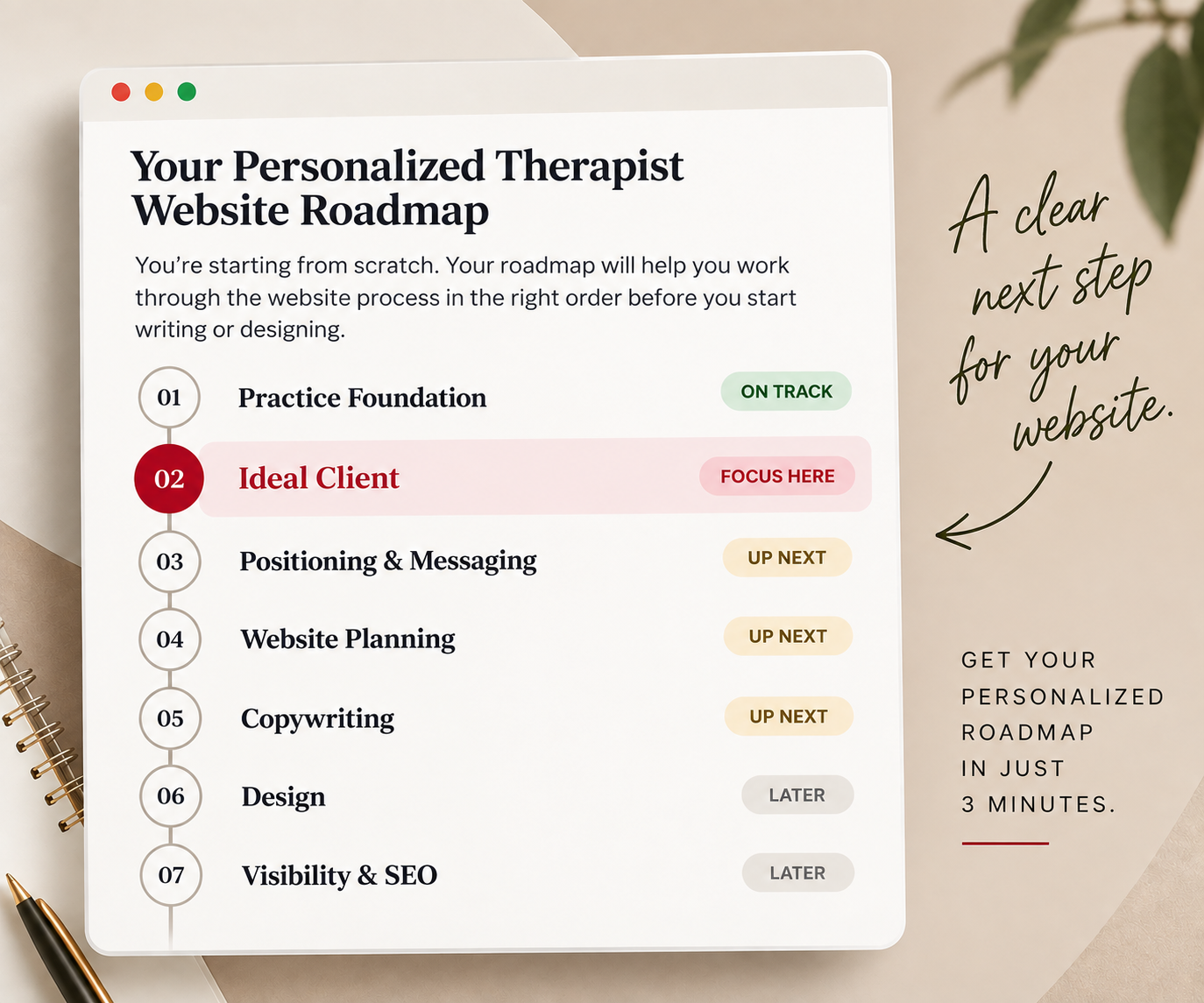
NOT SURE WHERE TO START WITH YOUR WEBSITE?
Find Out What Deserves Your Attention First.
Your website has a lot of moving parts. And whether you're starting from scratch or trying to improve the website you already have, working on everything at once isn't the answer.
Take my free 3-minute Therapist Website Assessment and get your Personalized Therapist Website Roadmap showing you where to focus and what comes next.
3 Tips for Getting This Right
Start with strategy, not design. I know the design is the fun part. But if you start there, you're building on a shaky foundation. The strategy tells the design what to do. Get clear on your brand first and the rest of the process gets significantly easier and faster.
Write for your ideal client, not for other therapists. This is one of the biggest sticking points I see. Therapists write their websites in clinical language because that's how they were trained to communicate. Unless your ideal clients ARE therapists……your ideal clients are not and you have to speak their language. They're a person who is struggling and searching for help. Write in their language, not yours.
Don't treat SEO for therapists as an afterthought. SEO isn't something you sprinkle on at the end. It needs to be baked into your copy and your site structure from the beginning. When your messaging is clear and specific, SEO becomes much easier because you're already using the language your ideal client is actually searching for.
You just read about all four elements. Now take the first step and book your FREE Discovery Call to learn about my S.I.T.E. Prep Method™ and start building your brand strategy foundation.
Common Mistakes to Avoid
Building the website before doing the strategy work. This is the most common and the most costly mistake I see. Therapists jump straight to design because it feels productive. But a website built without brand strategy is just a pretty placeholder. It looks like a real business asset but it's not functioning like one. The strategy has to come first, always.
Copying the language from other therapy websites. I get it. You're staring at a blank page and you have no idea what to write, so you look at what other therapists are doing and model it. The problem is that most therapy websites sound exactly the same. Vague, generic, interchangeable. When you copy that language, you disappear into the crowd. Your website needs to sound like you and speak to your specific ideal client, not like a template someone else already used.
Thinking SEO for therapists means stuffing keywords everywhere. SEO isn't about cramming your city name and your specialty into every sentence on your homepage. That approach actually hurts you. Good SEO for therapists is about clarity, specificity, and structure. When your messaging is clear and your site is well organized, search engines can understand what you do and who you serve. That's what gets you found by the right people.
Waiting until the website looks perfect to think about whether it's working. A lot of therapists spend months tweaking fonts and photos and never stop to ask, is this website actually bringing in the right clients? Your website is a business tool. It needs to be evaluated like one. If it's not generating inquiries from aligned clients, something in the four elements is missing or weak. That's the question to ask, not whether the color palette is right.
What to Do Next
Your website is the foundation of your private practice. The one platform you own outright, the one that builds equity over time, and the one that works for you around the clock even when you're in session. When all four elements are working together, it stops being a thing you have and starts being a thing that works for you. That's a very different experience.
If you read this post and started mentally checking off which elements your website is missing, that's exactly where I want you to be. The next step is doing something about it. Start with the free Discovery Call. It's going to help you get clear on the process I use to help you get clear on your brand strategy foundation, which is the first element and the one that makes everything else possible.
Click this link book your FREE Discovery Call 👉🏽 FREE DISCOVERY CALL
And if you're ready to have all four elements built for you, that's exactly what I do.
Let's talk.
You're a fantastic therapist. All you need is a clear website plan, and I gotchu.
Until next time,
Chrys
Keep Exploring
Before You Start a Private Practice Website, You Need to Read This
Therapy Website 101: A Beginner's Guide to Private Practice Marketing That Converts
What Is Brand Strategy? How to Get Clients as a Therapist
Best Therapist Website Design: What Actually Works (2026 Guide)
FAQ’s
Do I really need all four elements or can I just focus on SEO for therapists and get clients that way? SEO for therapists is a visibility tool. It helps people find your website. But if your website doesn't have clear brand strategy, strong copy, and easy navigation, SEO just sends people to a website that isn't ready for them. They find you and then leave. All four elements have to work together for your website to actually convert visitors into inquiries.
I already have a website. Do I need to start over to fix these four elements? Not necessarily. Sometimes a website needs a full rebuild and sometimes it just needs strategic updates to the copy and structure. The first step is figuring out which elements are missing or weak.
How long does it take to build a website with all four elements done right? It depends on where you're starting from. If you've never done brand strategy work before, that piece alone takes real time and thought. Rushing it costs you on the back end. When I work with therapists, we do the strategy and messaging work first and then move into the build, so by the time the website goes live, every element is already working together.
Can I do my own SEO for therapists or do I need to hire someone? You can absolutely learn the basics of SEO for therapists and implement them yourself. A lot of it comes down to using clear, specific language throughout your website, which is also just good copywriting. Where therapists tend to get tripped up is in the technical side of SEO, like site structure and metadata. If writing and strategy aren't your strong suit, working with someone who understands both the clinical world and website strategy is going to get you further faster. But, I encourage therapists to learn the basics, so they can manage on their own (at least in the beginning) and know what to look if they decide to outsource.
Why does my website sound like every other therapy website out there? Because most therapy websites are built from templates and written by people who aren't therapists, or by therapists who are writing what they think sounds professional rather than what their ideal client actually needs to hear. Generic language is the default because it feels safe. But safe copy that could belong to any therapist helps no one. Specificity is what makes your website work. And specificity starts with brand strategy.
Ready to Build Your Foundation?
Book your FREE Discovery Call and take the first step toward a private practice website that actually works.
And if you're ready to have all four elements built for you from the ground up, check out what that looks like with the S.I.T.E. Prep Method™.
